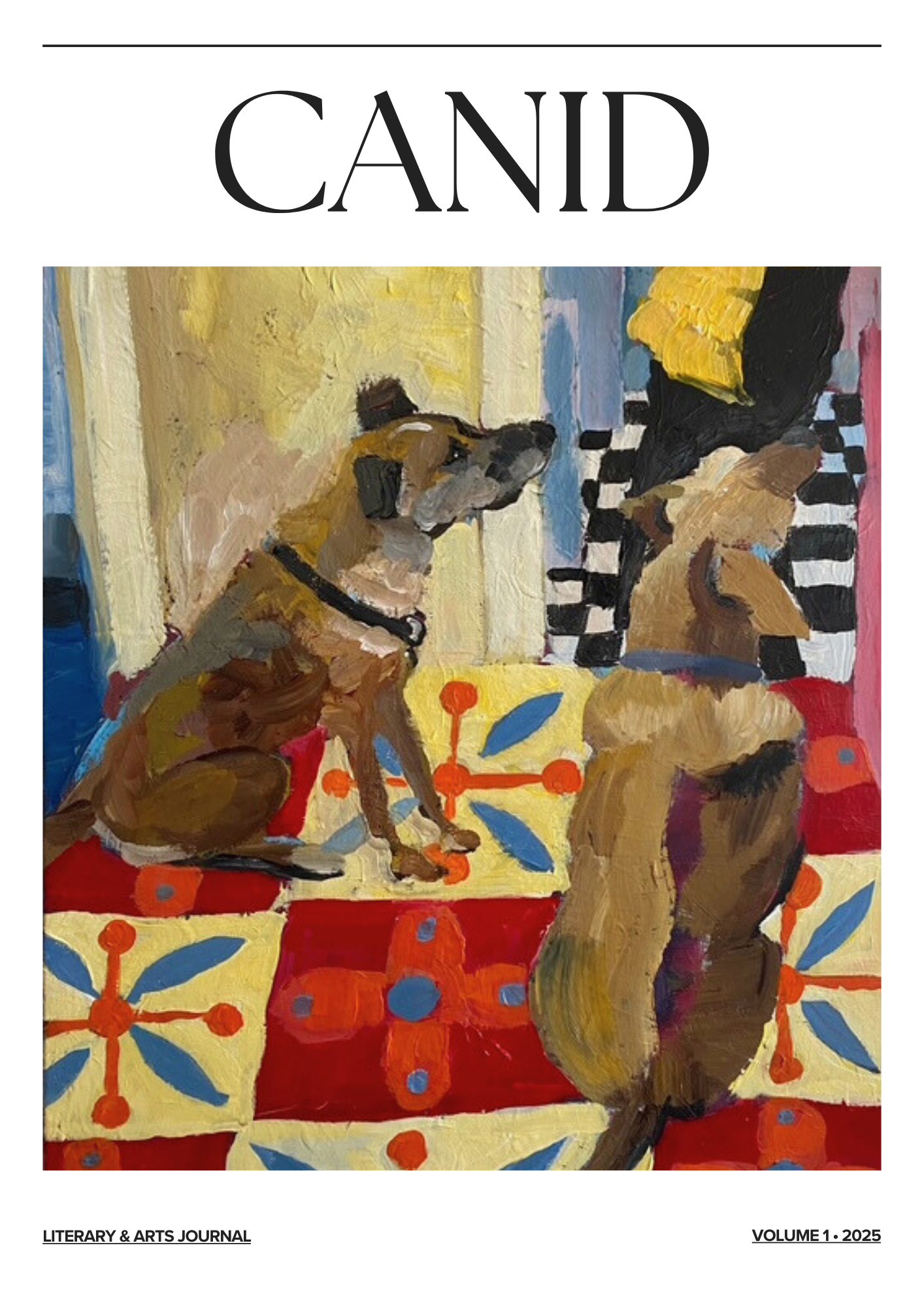

Volume 1

Editor’s note
Keli O’Connor
Dogs.
For upwards of 40,000 years, humans around the world have kept close proximity to our four-legged best friends—first as wolves picked the bones of our feasts outside of camps and later as we taught them to hunt beside us—and more than ever, we love our furry (or hairy, or hairless) canids as if they are a part of our families. Recent studies suggest that nearly a third of the world population keeps at least one dog, be it as a pet or working animal, and that over 900 million dogs are roaming around on this spinning blue rock.
Dogs have evolved beside us, from guardians to bed warmers to the companions we adore today, and our symbiotic relationship runs so deep between us that our brain chemistry and structures have changed to better align with one another. The loyalty of the dog to their human is unrivaled; friendships erode, marriages break down, families fracture and splinter, but a dog will never walk out on their person. A dog will never tell a lie or stab a back, never manipulate you, aside from the occasional puppy dog eyes for a bite of your food (which, by the way, dogs evolved as a means to win our hearts and our dinner over 10,000 years ago).
Still, dogs get the short end of the stick. Many are hurt or abandoned simply for existing. Shelters across the United States are over capacity because when money is tight, dogs are the first to get scrapped from the household budget. Yet, when these dogs are given the gentle touch of a pet or the comfort of a cooing admirer, they can learn to trust people again. And frankly, this defies all logic. A dog can and will survive on its own (or in formed packs) without any human interaction, but that formation in their brain—that ancient pull from their ancestors—grants us unconditional love.
As a species, we owe a great deal to dogs. Our entire existence, really. When environmental disasters and predators wiped off our closest hominid cousins, the dogs by our side kept us safe, warm, and fed.
So, while it is not nearly as much as they deserve, I am gifting dogs this journal. Through contributor donations, we’ve been able to give $75 to various animal shelters across the US, and proceeds from the sales of the journals will go to Faithful Friends Animal Society in New Castle, Delaware, a no-kill shelter and community clinic that saves countless dogs, cats, pigs, rabbits, and other small mammals every year. I truly hope that these stories, essays, poems, photographs, and paintings inspire you to extend some compassion to our species’ closest companions and that you enjoy our first collection at Canid.
Keli O’Connor
Editor-in-Chief
Poetry
Michael Alcée
Canis Major
I wasn’t surprised
when Jane Goodall
called you her favorite.
Alpha and omega,
always retrieving us
when we’re lost:
what’s that Lassie,
Timmy’s fallen
down a well?
Even those invisible eye muscles—
levator anguli oculi medialis—
secret spell
of your bottomless kindness.
As below, so above,
brightest star thou art
in our small universe.
Before hunting with Orion
you once companioned Isis,
goddess of motherhood
and magic.
It’s no wonder
we look up to you now
while leaning in
to pet your furry mop,
bracing against our palm
with your own benediction
for unbalanced two-leggeds
here on earth—
your arched, twinkling eyes whispering:
good boy.
Resting Potential
“Creativity is then the doing that arises out of being”.
—Pediatrician/Psychoanalyst Donald Winnicott
Maybe you remind us—
with your thrice turning
to cozy into your resting
potential—how we begin,
being before doing,
how electricity conducts
itself from the ground up,
how we might live,
if only we remembered.

Michael Alcée’s work has appeared in San Antonio Review, Psychoanalytic Perspectives, and Tarry and is forthcoming in Eunoia Review, Black Iris, Inflectionist Review, Literary Cocktail, Quarter Press, Syncopation, The Branches, and The Raven Review. In addition to being a poet, he is a psychologist and author of Therapeutic Improvisation (Norton, 2022) and The Upside of OCD (Rowman & Littlefield, 2024).
Arielle Arbushites
Yours, then Mine
Oh, how she howled the night you died.
I didn’t know why—
and then I knew why.
She climbed into bed, rested her head,
and had a good cry.
We had a good cry.
I took her in when you grew frail,
before your ship set out to sail.
Still, some part of her stayed with you,
some piece of peace I never knew—
until the night she raised her cry—
I didn’t know why—
and then I knew why.
It was the night you died.
A long, sustained sound—
Oh, how she wailed to no avail.
I didn’t know why—
and then I knew why.
How is a dog a woman’s best friend?
Yours, then mine—
we shared her time.
All gray and lonely,
she fell to sleep,
howling low, her soul to keep.
Oh, how she slept the night you died.
She might have wept,
if she had tried.
She carries your life in every step,
in every day that we have left.
I keep her close, I’ll carry her through—
a promise kept, from me to you.

Arielle Arbushites is many things, but above all she is a mother and a licensed social worker who has been a writer all her life. She has mainly published poetry on social platforms and lit mags, but also debuted a short poetry collection in 2024 entitled cracking at the heels. Arielle creates custom poetry on the spot for folks searching for human connection and performs spoken word poetry in her local community.
Marianna Gibson
For Little Maple
As if I’d stopped to ask
the question before—whether
or not she knows the things
I have not told her. How naive
to assume myself wiser. Just this
morning, she ran straight through
the fence, puddles of farm mud,
to wild berries at the wood’s edge.
Her teeth bare at the new neighbor.
Ripeness, perhaps, is what a dog knows.
When tenderness pools beneath a heart
bruise, when the world is terrible, why
fur at her nose begins to grey so soon.
She isn’t worried at all––mouth full
of summer fruit, belly up to the hot sun
––if I could run like her toward anything.


Marianna Gibson is a graduate student at Kennesaw State University. In addition to her studies, she teaches High School English full time and manages a small homestead in North Georgia.
Hillary Gonzalez
The Soft Brown of Dog Eyes
I first saw him in the alley–
the one where the feral cats
roamed among the discarded trash
of the whole neighborhood.
His heartbreaking cries drew me to him,
while his puppy eyes begged
me to love him.
I am a friend to dogs
and all small animals,
but it wasn’t until I reached
out my hand to him, to stroke
his fur and offer comfort
that I truly loved him.
He shrank, and his eyes looked
at me, with a pleading look
I recognized so well as,
please, please love me.
Please, please do not hurt me.
Oh, sweet boy, I said–
I, too, am trying to escape
my terrible past.

Hillary Gonzalez (she/they) is a Baltimore based queer, disabled, and AuDHD poet, whose work explores themes of nature, identity, and healing. They are the authors of Seasons, and the ecopoetry collections, Wild Unfelt World (2026 Gnashing Teeth Publishing), and Where the Osprey Nest (Palewell Press 2026). Their poems have been published by South Broadway Press, Cosmic Daffodil Journal, and in anthologies by Bi+ Book Gang, Yellow Arrow Publishing, Loblolly Press’ anthology: Understory, a fundraising anthology for the victims of Hurricane Helene, and In Praise of Despair, an anthology for disabled artists and writers by Beyond
the Veil Press.
John Grey
People and Dogs
People are their dogs and I’ve dated poodles
and showy afghans and more than one
beagle that never could stop sniffing around me.
But what am I to make of woman who comes with basset hound?
Her tail wags. That’s a good sign.
But the eyes droop, slop down the checks
that flop over the jaws. And her gut is low
to the ground, almost sweeps it as she trots
across the carpet. And what of those ears,
brown face cloths, longer than the drooping
head and stubby legs combined. Her owner is
slim, petite and upright and her body parts stay
in their spheres. So why a basset hound, I wonder.
And why me. And then she confesses how
she’s minding the dog for a friend who’s on vacation.
People are their dogs but they’re not the dogs they sit.
The date’s a failure. She spends the whole time
waiting for someone to come for me.

John Grey is an Australian poet, US resident, recently published in Shift, River And South and Flights. Latest books, “Bittersweet”, “Subject Matters” and “Between Two Fires” are available through Amazon. Work upcoming in Rush, Spotlong Review and Trampoline.
Kerry J. Heckman
my soulmate is an old dog
fireworks start two days early in Seattle
though he can’t hear them anymore
some parts of his fading are easier than others
we can sneak out of the house without him noticing
he’s back sleeping in our bed
his bark is softer and less frequent
he loves bigger
screech owl legs too long for his body
black and white like an orca
with a harbor seal’s forlorn dark eyes
to anyone who passes on our walks
I say he’s old or he has cataracts
explaining why he twitches
when his eyes cross a shadow
the vet says to pay attention to when
he is no longer interested in walks or food
eventually he will tell you he’s tired
I watch him with eight eyes of a spider mother
and give him whatever he wants:
bits of hot dog & cheddar cheese
belly rubs until he falls asleep
snail paced walks to the coffee shop
where they have the good biscuits
I’ve memorized the rise & fall of his ribs
to make sure he is breathing
please never stop breathing
uncomplicated love is the hardest to imagine
this complicated life without
seventeen years and I still call him baby
I don’t know if I’ll write about him when he’s gone
grief so wild it won’t stay between the lines
but it’s already here—the grief of knowing it won’t be long now
eventually he will tell you he’s ready to rest


Kerry J. Heckman (she/her/hers) is a psychotherapist and writer based in Seattle, home of the Coast Salish people. She is currently pursuing her MFA in Creative Writing at the Rainier Writing Workshop at Pacific Lutheran University where she serves as editor at the program’s journal, Soundings. Her work has appeared in North American Review, Multiplicity Magazine, and Thimble Literary Magazine, among other publications.
Steven Horton
All Dogs At the Ferry Terminal
“All dogs,
the ferry is now arriving.
Please return your owners
to their correct cars.
Please make sure
they’re fully awake,
off their phones,
and their cars will start.
Teacup poodles,
and chihuahuas,
no bathing
on board the vessel.
Saint Bernards,
beer only in the galley.
If you have insight
on how the place smells,
bark scientifically
at any crew member.
Ahoy canids,
this is the last leg up.
Please use the baggies.”
It’s Not the Dog’s Fault
It’s not the dog’s fault,
or the bright sunlight,
the fluffy white curls
in a hot pink harness
matching silk barrettes,
short-stepping cutely by,
her owner announcing:
“She just came straight
from the beauty shop.”
I admire her pure-pedigree,
flamingo-colored shades,
the rhinestone frames.
She’s a scented puff,
powdered by pure
extravagance.
I wonder, from the rear,
does she even poop pink?

Steven Vincent Horton was born in San Pedro, CA in 1947. He graduated from Torrance High School in 1965 and he served in the United States Army, 1967-68. He earned a B.A. degree in History (Long Beach State, 1973), an M.A. in Education/ Special Education (Boise State, 1979), and a Ph.D in Education/Special Education (University of Washington, 1984). Steven began writing poetry in 2019 and he has published five collections to date. His current work is appearing on a regular basis in literary journals both within the U.S. and abroad.
Lin Laguna
Haiku
strolls, half-awake when
rays of dawn illuminate
fur and flesh, basking
weekend companion
tail-wag joy relinquished
bittersweet farewell
howl-along harp song—
our spontaneous duet
fondly remembered
Lin Laguna (she/her) is a Filipino American writer based in Florida. Fueled by matcha, she spins speculative tales of wayward women. When not worldbuilding, she enjoys capturing poignant moments through microfiction and poetry. Connect with her @linlagunawrites.
DS Maolalai
A italian greyhound
what’s that – that a italian
greyhound? he was bent
down already
giving margot a scratch
round the chin. a whippet
I told him. just small
for her size – immediately
felt like an idiot. a whippet
he said not even noticing. she’d come
right up to him. my dog has an instinct
for people which I’ve never shared.
it would be much easier
saying yes to whatever they ask me.
who really cares what a dog is?
Margot
trying to write poems
with a puppy in the room
is worse than having
no wine or no laptop, and very
few cigarettes left. that bouncing
pounce batting a tennis ball.
the occasional nose
on your knee.


DS Maolalai has been described by one editor as “a cosmopolitan poet” and another as “prolific, bordering on incontinent”. His work has been nominated fourteen times for BOTN, ten for the Pushcart and once for the Forward Prize, and released in three collections; “Love is Breaking Plates in the Garden” (Encircle Press, 2016), “Sad Havoc Among the Birds” (Turas Press, 2019), and “Noble Rot” (Turas Press, 2022).
Dominique Miller
Two Happy Souls
21:12pm
We are in need
of a shelter
against steady rainfall
and sleep
that creeps upon us.
We ventured freely
all day, in the wild;
crossed waterfalls
& meadows,
plucked blueberries
ripe and round
that stilled our hunger
and stained our tongues.
Our canvas shelter
built as an architect
blends
with our surrounding
of soft moss, lofty pines
and an overhang
of dark clouds.
The cool of our skin
confirms
what our eyes take in
as we sew ourselves
comfortably
into our sleeping bag.
The night falls
like a silk blanket
around us, its fabric
finds the shape
of our bodies, a spider
finds its way
in the corner of our tent.
Moon light filters
through an opened zipper
to find us, curled up,
on a natural bed,
where a few crickets
try to charm us
to sleep.
1:35 am
Our eyes still open
as raindrops bounce off
our tent, in a rhythm
that we have heard before …
… I reach for my guitar,
play this memorable melody
and study my dog’s face
to find a trace of white
on his black chest, a bow-tie
of an Italian tenor.
I sing
“Nessun Dorma!”
. . . he lifts himself up, howls
his part of the aria
and becomes the star of the night.

Dominique Miller is a Dutch-American, dog-lover, and a Minnesota-based poet & illustrator. She creatively expresses herself through words and imaging, inspired by her experiences in life, love, cultures, and human connection with the natural world. Dominique’s poems have appeared in magazines—print and online—and have been included at local art exhibitions.
In 2025 Miller published her first full-length collection of poetry, titled OUTSIDE(R).
For more information: http://www.dominiquemiller.com
Reagan Prior
Jar in my Closet
My jar is hidden in the back of my closet
Poked and prodded by stuffed animals
Old school projects and clothes that no longer fit
It holds the orange pink sunset
and the guilty sound of
A dog’s feet wet from tracking mud in the house
A corner of a quilt from my grandmother’s house
A bitter warm drizzle of coffee
The jar holds sad melted crayons
and rosy cheeks that still have baby fat
handfuls of burning planets
clippings of dead hair
the crunch of movie theater popcorn
My jar is hidden in the back of my closet
untouched by the rays of moonlight
that expose all that is meant to be
unseen,
unheard,
and forgotten.
Reagan Prior holds an MFA from Drexel University, and is currently working on a upmarket mystery novel. She has been previously published in Glass Mountain, Drunk Monkeys, and Soundings East. She has two silly boxers who love making a mess.
Jon Raimon
three dogs
brindled and worried, Carver boy barked
scared passersby, castled our hearts
skittish and bonded, Nellie girl snarled
bit clueless skaters, a family caroled
bounding and wolfy, Freya loped out
of the Texas tundra, Valkyrie eyes
first dog at 27 after the death of my father
it’s the cheap rug
it’s his funk, a swamp
anxiety, a lost
boyhood brindled, bristled
into the stair landing
still there
back then
October became January
the home went still
but not you, mourner’s
eyes on the quiet
on me
still here
French Canine at Heart
in memory of Carver Raimon on his birthday*
Born on Bastille Day
a revolutionary at
play — spinning circles,
tighter and tighter,
a declaration of,
a guillotine drop with,
glint and joy: above all
Fraternité with me, just
as true pain, like the blade,
had taken my father
It was the Égalité of sorrow,
my haunting the quiet home,
his dark muzzle forlorning
right by my belly, my chest.
His brindled, ever burred up
fur kept me warm that winter,
his eyes never expectant,
just as present and sad
as we needed
We both found Liberté
in the undergrowth,
tunneling, bushwhacking,
searching for something
in the frozen forests
we could not dig up
in our home.
Something lost. And
something made:
loyalty to space
and care. A
Rousseauian
acceptance of
the senses. That
winter, that spring,
those years, he ran
alongside my grief,
never demanding
anything except
good cheese and
the love of touch,
two fine
French gifts.
*Yes, my dog was named after a very non-French writer, but the downbeat honoring of real relationships and struggles in Ray Carver’s stories seemed to fit my pup’s temperament, too.

Jon Raimon teaches writing in Ithaca, NY. His work explores grief, family, resistance, and all forms of love, including bonds with his canine pals. He is part of Spring Writes, Ithaca’s literary festival, and his work appeared in Haikuniverse, Quasar Review, Adirondack Center for Writing, Wilderness, and will soon be featured in Trampoline: A Journal of Poetry, The Turning Leaf, Book of Matches, Merganser Magazine, and The Bluebird Word.
Ona Siporin
The Dog
While they lie in bed dreaming of money,
of beautiful women and handsome men,
dreaming of flying above rooftops
or sailing across oceans,
he lies on the ground in his small house
listening to the night wind tangle itself
in the trees and reflects on only two
questions: Have I been a good dog?
Have I loved and protected my family?
These questions keep him awake.
No matter how often the people pat his head,
ruffle his fur, and feed him;
no matter how often they put their nose
to his and mutter Good Dog! Good Dog!
and walk away, there is still a nagging
uncertainty, the memories:
mornings around the block
when he peed on the neighbor’s lawn,
spring evenings full of exhilaration
when he ran away with a poodle
and stayed out all night; the day
he bit a workman digging near his bone,
the hot noon when, running free, far away
from home, he snarled at a stranger.
While they lie in bed, dreaming
their funny dreams of flying,
he lies alone, struggling
with these inner thoughts of justice,
fairness, the complexities of truth.
It is all on his shoulders. He must
spend hours on the ground, wondering,
Have I loved and protected my family?
Have I been a good dog?

Ona Siporin writes both poetry and prose. She has published two chapbooks of poetry and individual poems in various literary journals including: The Sun, Indiana Writes, cold-drill, Cimarron Review, Atlanta Review, Sackbut Review, and Cape Rock. Her prose includes Uncommon Common Women: Ordinary Lives of the West, coauthored with historian Anne M. Butler; Stories to Gather All Those Lost, a collection of short radio commentaries; and Leah Contarini Mysteries, a three-book series published by Level Best Books.
Lesley Williams
What kind of person
I thought
I was a cat person
But then
this nose,
those paws,
these eyes,
and my heart
fell in love.
So it seems
I am not a cat person,
But I am
a cat person
and a dog person
and you
are love.


Originally from Canada’s east coast, Lesley Williams now lives in northern Delaware with her family and two furry companions: Oliver, a tuxedo cat who is equal parts grouch and sweetheart, and Baymax, a lovable labradoodle with plenty of attitude. The pair are best described as frenemies who both love to cuddle on the couch with their favourite human. Lesley is an avid reader who also savors time outdoors, particularly walking in the woods with Baymax, no matter the season. She shares it all on her Instagram at @bookishgenxer and enjoys chatting about all things bookish
with fellow readers.
Beth Wolfe
Abcedarian for Nica
All dogs go to heaven they say, and I
believe it too, for where else
could such pure and loving spirits be
destined to go after
escaping the bonds of Earth?
Furry angels with coats and hearts of
gold, the epitome of
heavenly creatures.
Imagine the beauty of
knowing she’s waiting on the other side, her
love calling you to her,
making every day apart seem like
nothing, just a blink between goodbye and hello again,
only this time, hello is for good.
Perfectly matched, two beings unable to
quit loving each other,
revealing the
strength of connection, a
tether between our hearts, surpassing the
understanding of most. Your
valiant fight gave us more memories than we deserved, your un-
wavering loyalty still an anchor, your
xenial nature missed every time we open the door,
your mischievous antics still fodder for our stories, your
zest for sticks and ocean waves the hallmark of the dog we still adore.

Beth Wolfe has had a love affair with words for as long as she has been able to speak/sing/read/write them, but has only found the courage to call herself a writer within the past five years. Her go-to themes in poetry include strong women who speak their minds, her Appalachian roots, and the chemistry she taught decades ago. She lives in a home full of jazz music and dog hair thanks to her husband and Golden Retrievers, respectively.
Beth can be found online through social media (Facebook: Beth McCormick Wolfe, IG/Threads: @bdubs) and her website, bethwolfe.net.
Photography
Keli O’Connor


Keli is a novelist, artist, and the Editor-in-Chief of Canid Literary & Arts. She holds an MFA from Drexel University, and is the previous editor for The Spoonie Journal and The Paper Dragon. Her work has appeared in Spellbinder Magazine and Neuro Logical Literary Magazine, and her debut novel, Rehoming Breanna Huxley (Green Crow Press, 2025), received a Firebird Award for Neurodiversity. Keli lives in Wilmington, Delaware with her three rescue mutts Tofu, Miso, and General Tso.
George Petner


George Petner is a podcaster, writer, and horror nerd from Philadelphia. His work has been published in Limited Editions. When not writing, he is fronting a sophomoric punk band and playing Magic: The Gathering.
Rachel Turney


Rachel Turney, Ed.D. (she/her) is an educator and artist located in Denver, CO. Her poems, research articles, reviews, and drawings can be found in a variety of publications. Rachel is passionate about immigrant rights, teacher support, and empowering other artists. She is a Writers’ Hour prize winner, Best of the Net nominee, and her photography appears on a few magazine covers. Rachel is on staff at Bare Back Magazine with her monthly column Friday Night in the Suburbs. She is a reader for The Los Angeles Review. Her poetry collection Record Player Life is forthcoming with The Poetry Lighthouse. Stay tuned and keep writing!
Website: turneytalks.com Instagram: @turneytalks Bluesky: rachelturney
Creative Nonfiction
Brittany Files
Funeral Procession
The third time I saw my father cry, I didn’t even notice through the veil of my own tears. He was the first one I saw when I opened the door, gingerly, unsure of what I’d find inside. He hugged me longer than I remember him ever hugging me, and I’m still not sure if it was that gesture or my dead dog on the couch that brought on the choking. When I pulled away, partly because it felt so foreign to be held by him like that, I noticed the way his face mirrored my own. Not just because I look so much like him, but because our eyes—the ones we share—were both puffy and bloodshot and wet. I’d seen him cry only twice before then. Once during his military retirement ceremony. The other during family movie night watching The Bucket List. There was something about that Morgan Freeman-Jack Nicholson flick that elicited a response even the birth of his own children couldn’t. That, and the unexpected death of my beloved childhood dog in the middle of the night.
Luna was wrapped in an old lace comforter that was certainly older than I was, and rigor mortis had begun to set in long before I stumbled out of Danny’s car and into the house in my sweat-soaked, tear-stained pajamas. She was peaceful in her little cocoon, laying in the place on the couch that had been hers since I was in training bras. From behind, I could almost believe she was asleep, save for the absence of the slight movements that indicated air was entering and leaving her cancer-ridden lungs or the occasional sigh that reminded us we hadn’t acknowledged her presence for a moment too long. But from the front, it was obvious. Her eyes wouldn’t close all the way; her tongue poked just slightly from between her lips and had begun to dry. It was cartoonish. Cliché in a way that brought a laugh through my lips that quickly dissolved into a sob.
***
She was Susie originally. The moment my mom and I saw her photo, we both gasped. She was staring up at the camera in this pitiful way and one of her gigantic yellow ears was flipped back, almost as if she was tucking her hair behind her ears and throwing us a coy glance. Aren’t I so cute? You know you want to take me home. And I did. I did want to take her home. But my mom hadn’t promised me anything, and my dad, who was working out of town long term, had to sign off on it, so I simply daydreamed about little Susie and how soft her big ears must be.
My first childhood dog, Elvis, whom my parents got before Nick and I were born and who passed away when I was nine, was a difficult loss for my mom. She shared a special bond with him, the way you do when you raise a pet from their babyhood. My brother and I begged for a dog for years after he passed away, but my mom wasn’t ready. We had three cats, so it wasn’t as if we were in desperate need of a pet.
Eventually, she began to consider the possibility of another dog a bit more seriously. I was in seventh grade, a tough year for probably everyone but particularly for me, and my family was moving out of state the following summer to join my dad in his long-term out-of-town workplace. I’m not sure if it was the timing or the upcoming move or how shitty my year had been—maybe a combination of all three—but around my thirteenth birthday, we began looking at adoptable dogs from the local shelters online. And that was when we found Susie.
On the way to gymnastics, a random day after school, we made a detour.
“Where are we going?” I asked my mom. A backseat driver, even at twelve.
“Shortcut,” she said. She could barely contain the smile threatening to creep up to her eyes.
When we brought her home, it became clear that I was expected to step up. I was a big girl now, with big girl responsibilities. I was supposed to help take the dog out for potty breaks, fill her food and water, clean her poop from the yard. And despite the added work, I was excited. By the time the summer hit, she and I had fallen into a nice routine.
Prior to her arrival, I had not been allowed to walk around the block by myself. It was a long way around, and my mom, being the most paranoid woman I know, was convinced I’d be abducted. But now that I had a dog, things were different. Some sort of yellow lab-beagle mix, Luna—as we renamed her—was known for peeing herself in excitement and exposing her belly to pet upon meeting strangers. She was twenty-five pounds of pure terror, certain to scare off the child predators.
We would walk for what felt like hours, me with my iPod nano in my pocket pretending I was in a music video, her trotting along with me, ears blowing in the breeze. She was a curious pup, nose always to the ground, pulling me in all sorts of directions while she chased a scent. And she was fast. We discovered that the hard way. So, during our walks I was careful to not let her believe she was in control, though I can’t say I was successful.
There was a week that summer where my mom, Nick, and I were all sick with some sort of stomach bug, something one of us picked up at school probably. And because the world is a cruel place, Luna also got sick. She was having explosive diarrhea all over the—white carpeted—house. So, while my poor mother was taking care of two sick children and herself, she was also scrubbing dog shit out of the carpet.
Even amid her episodes, Luna was in good spirits for the most part; however, I was convinced this was the beginning of the end. Either she was dying, or my mom would be so mad she destroyed the carpet that she was going to send her back to the pound. My worst fear had come true: I couldn’t keep her. When we took her to the vet, I picked my cuticles apart waiting for the bad news sure to come.
But instead, what we got was this: Luna had a parasite. A parasite that animals get only from eating other animals’ feces. She had been eating shit on our walks—others’ and her own, probably. All that time she had her nose in the grass, she was guzzling turds like it was a full-time job. With a course of medicine and a bit more diligence on our walks, she would be good as new in no time. As the vet explained her ailments and the treatment plan, Luna sat next to us, a literal shit-eating grin on her face, completely unaware of the havoc she had wreaked. I kissed her forehead, and she tipped her head back to return the favor. Even after the news we had just received, I let her kiss my face anyway.
***
“That’s supposed to be a truck, in case you were wondering.” My dad pointed ahead at the Tesla monstrosity, trying to redirect our attention from the sniffling coming from the driver’s seat. “Looks like something out of a science fiction movie from the seventies.”
My mom and I sat in the backseat, Luna’s body draped across our laps, and my dad was complaining about the aesthetic displeasure of the Cyber Truck. Danny, seated on the passenger side, chuckled out of obligation as good boyfriends do.
In the parking lot, my dad backed into a parking space, and he and my mom bickered about whether he should park around the corner, closer to the front door. But the truck was too big, he said, and the parking lot too small. To which my mom responded that she always parks around the corner and her truck is just as big. Even Luna rolled her eyes. As they went on like this, and my dad eventually left to let the vet know we had arrived, I stared at the preschool across the street, where the children were on the playground swinging and running and laughing and squealing.
When my dad returned, my mom and I shuffled around in the backseat, careful with the transition of Luna from lap to arms, and I began to understand why people taxidermy their beloved pets.
I wasn’t ready to let her go. Couldn’t imagine a world in which I walked through the door of my parents’ home and she wasn’t there to greet me, tail wagging so fast she nearly folded her body in half. I hadn’t even gotten to say goodbye, not properly. I had stopped by the house the day before she died to pick something up, but I was so wrapped up in whatever meaningless task I was late for that I couldn’t remember if I even said goodbye to her as I always did. She was with me through nearly every pivotal moment of my sentient life: my first period, my first (and fourth) heartbreak, my high school and college graduation. And now, faced with the task of handing her stiff body to my dad to carry her to her resting place, I wasn’t ready. I would never be ready. But I did it anyway, because, despite every urge telling me to keep her, I just could not resign myself to be the weird woman with her childhood dog taxidermized on the mantle.
So instead, we led her, single file, through the back door of the vet’s office. The techs shaved the hair between her toes, trimmed her always unruly claws, pressed the pads of her foot into ink for one last morbid souvenir. I kissed her downy ears, softer than my twelve-year-old self ever dreamt. As we covered her one last time, somewhere across the street, some child, probably with a dog of her own waiting for her return, threw her head back, throat to the sky with unadulterated glee.

Brittany Files is the former managing editor of The Headlight Review, Kennesaw State University’s graduate literary magazine. She writes primarily creative nonfiction and screenplays, though, ironically, her only piece of published work is poetry, published by The Kudzu Review. Her television pilot. The Widow-Maker, placed recently at the Austin Film Festival. In 2023, she received a scholarship to the Fine Arts Work Center in Provincetown, MA, where she cultivated her love for chilled lobster rolls and film photography. She lives in Sandy Springs with her two cats and many unfinished home decor projects.
Taylor Harrison
Finding Dog
My face was splotchy for days after Nila, the elderly cocker spaniel my husband and I had rescued two years prior, passed away from a malignant cancer. We had done everything to prolong her life, even opting for surgery to remove the tumor from her spleen. Despite being told her diagnosis was terminal, I maintained my conviction that she would magically heal from this incurable ailment. She’s fine, she’ll be OK, I’d tell my husband, L, who was my boyfriend at the time, up until she took her final breath in our arms. Through her death, I was forced to reckon with the realization that all the medical intervention in the world can’t save someone you deeply love when it’s their time to go. I would face this reality once more when my beloved sister-in-law lost her battle to cancer four years later. Nila’s fate made me reflect on my own mortality as well as the mortality of my loved ones, which had seemed like a distant concern to me at twenty-four. How can a living thing just disappear? I asked myself repeatedly, catching my hunched-over reflection in the mirror and grazing my fingers along my face to confirm that yes, this moment was really happening. No, it was not a dream. She was really gone.
I stayed in bed for two days after she died, because any time I was reminded of her—like when I noticed how cold and lifeless the apartment was without her, or when I caught sight of her favorite spot in the afternoon sun that was now empty—I became inconsolable.
“We should get another dog,” L said to me on the second day, sitting on our bed. “We shouldn’t wait too long.” He reminded me that his sister had waited twenty years to get a new dog after her cherished springer spaniel, Scooby, had passed away.
“We can’t,” I said, fighting back tears. “She’s just left us. It’ll be like replacing her.”
He handed me his phone. I swallowed hard as I held the device, glowing in my hand like a beacon of hope. There were dozens of ads for dogs either being rehomed or for sale. I scrolled down, feeling as though I were online shopping, or worse, online dating. I can’t. I hadn’t noticed that he’d left the room while I was clicking through each page, my heart aching when I came across a puppy with an all-black coat that resembled Nila’s. Can we get another dog? No way.
After a couple of hours of off-and-on scrolling, I came across an urgent ad for a male cocker spaniel puppy that needed to be rehomed. His fur was red and white, and he had pale freckles that dotted his snout. He didn’t seem to have a name. He was four months old.
“Dal,” I yelled out to L from the bedroom, short for “darling.” He walked in, and I held up the phone.
“See?” He said. “It’s not too soon.”
“I’ve never had a puppy before,” I said. While the prospect of raising a puppy was already daunting, the truth was that he wouldn’t be Nila. He wouldn’t have her mannerisms I fell in love with. He wouldn’t climb onto my chest like she did when I was suffering from a bout of anxiety or depression.
Maybe there is another dog out there that will be exactly like her. I should keep looking, I said to myself.
“Come on,” L said. “You never know.”
I mulled it over for a few moments. Just because you’re inquiring about the dog doesn’t mean you have to adopt him, I thought. I decided to draft an email to the jumble of letters meant to obscure the poster’s email address.
I’m contacting you to ask if your cocker spaniel is still available—I unfortunately couldn’t find a number in your ad, but mine is –
I hit send, instantly regretting having reached out. I hoped that it would go into the ether, that I had left off a crucial letter in the email address and I would get a boilerplate failed delivery message.
“I don’t think this is a good idea,” I said to L. I clicked back at the single photo that was posted. It was far less polished than the other photos of puppies, and I wondered if the ad could be a scam. They were asking for a decent rehoming fee. I wished that it was for my sake, so I could put off entertaining the idea of another pet so close to the death of my soul dog.
“Let’s just see,” L said.
A few moments later, my phone vibrated with a text from an unfamiliar number.
Hi, it read. Can you talk?
***
Three days later, we were on the road to Coronado, California, which was four hours south of where we lived. We had arranged to meet the owner of the puppy. Until that morning, I hadn’t realized what I had done—none of it felt as though it was a certain plan. I had been on autopilot, operating under a dense, grief-fueled haze. Throughout my communication to the owner, I had said to myself that I could always back out, then suddenly, I couldn’t anymore.
“You have to do it,” L’s sister said over the phone before we made our decision. I continued thinking how I would get out of this as her voice filled our bedroom while we lay in bed. I wasn’t ready.
“This dog needs you,” she continued. We had learned that a single mother was caring for the nameless cocker spaniel, but that the responsibility of a puppy had become too difficult to manage with her young son and challenging school schedule.
“We’re doing it,” L said, and resigned to my fate, I understood that it was the right thing to do.
We arrived mid-morning, the sky wan and impenetrable. I was looking for a sign from Nila, or God, or some other higher power since I was an agnostic, hoping that a rivulet of sunshine would pour through the clouds, a distant rainbow materializing even though it hadn’t been raining. It was not lost on me that “God” spelled backwards was “Dog,” and I thought perhaps that was the sign I was looking for.
We were early, so we walked around the downtown area, and then we parked in front of a Spanish-style apartment complex with lush foliage. I got out of the car and paced nervously. My phone rang.
“We’re almost there,” the voice on the other end said.
About fifteen minutes later, after I had watched innumerable cars drive slowly down the street and thinking one of them must be the nameless dog’s owner, a midnight blue Honda Accord pulled into the parking lot.
Here, the text said.
L and I walked sheepishly toward the car, and the door on the driver’s side opened. An attractive young woman with long highlighted hair got out and greeted us. She told us we would need to be quick and gestured toward the backseat, where a little boy in a car seat was holding what I first thought was a stuffed animal.
“Come on,” the woman said.
“No,” the little boy replied, and started to wail. The stuffed animal, now whimpering, wriggled free from his grasp. I froze, wondering how I could possibly undo this grave mistake.
Holding the puppy in her arms, the mother stared at me expectantly while L counted the small stack of bills. Finally, I reached out my arms to cradle the tiny creature.
“Here you go,” L said.
“Thank you,” she said, putting the money in her pocket.
***
Like the many animals I grew up with, Nila had a nickname that had seemingly come out of nowhere. One day, we started calling her “Nelly,” and it stuck. L and I knew that if we adopted this dog, we would name him “Nelson” in honor of Nila’s nickname. When we sat in the car and Nelson was fast asleep on my lap, I looked at him and couldn’t believe how much the name suited him. I exhaled, and the anxiety started to fall away.
“Nellllllsooooooon,” I whispered, holding the creature wrapped tightly in a blanket.
“Nelson!” L said, grinning.
Nelson looked up at us and blinked slowly. He seemed so soft, new, and fragile, that I was immediately fearful of something happening to him. Nila had been fragile, but not like this. I kissed the top of his head, which was large in proportion to his slim body and wiry tail.
“He’s perfect,” I said, really taking him in for the first time. “Look at his freckles!”
When my older sister gave birth to her daughter nearly five years later, she described an outpouring of love when the doctor handed her the baby, and how in that moment, she knew she would do anything to protect her child. I told my sister half-jokingly that I felt similarly when I met Nelson.
***
When we opened the door to our apartment and let Nelson inside, he immediately crouched down and defecated on our engineered hardwood floor.
“Guess he’s not potty-trained,” L laughed.
“No big deal,” I said, trying to play it cool. “Thank goodness we don’t have carpet.”
When it was time for bed, I plonked him on top of the covers, hoping that he would be as affectionate as Nila had been. He expeditiously urinated.
“Oh God,” I wailed. “What have we done?” I looked at Nelson, who resembled a Beanie Baby with his large hazel eyes.
“I miss Nila,” I sighed, tearing off the bed sheets and duvet cover.
***
Within a couple of months of having Nelson, he shared his sweet, loyal and intelligent personality. While he wasn’t exactly like Nila, I grew to love his other quirks, and although raising a puppy was difficult, the unconditional love I experienced was a welcome distraction from my seemingly unending grief. One morning, Nelson started his ritual of hugging my husband and me by sitting on us, one at a time, and stretching his arms over our shoulders. I held him tightly, reminiscing about when Nila used to cuddle with me to calm my nerves. We spoke to Nelson often, and in doing so, he learned words like “lizard,” “squirrel,” and “doggy.” L and I called his growing vocabulary “Nelson’s Dictionary.”
Soon, I realized I had gone several days without thinking about Nila, and then it was weeks. I experienced immense guilt—had I replaced her? I found solace in the idea that Nelson had been meant for our family. He found us at a time when we needed him most.
“Nila would’ve hated him,” L said to me while watching Nelson sprint around the living room with one of his toys. I remembered how calm she was, and how she preferred people to other animals.
“Yeah,” I said. “I think so, too.”
When Nelson was eight months old, a friend found a stray female kitten while on a trip. She brought her to the apartment in a carrying case, and I had a similar oh-no-what-have-I-done feeling as I unlatched the door and allowed her into our home and hearts. I hoped that Nelson would be good with cats given his inexperience with these strange creatures.
“Nelson, who’s that?” I said to him as he sniffed her blanket.
Within weeks, they were inseparable.
***
Now, Nelson is nearly five and dotes on our two cats, Suki and Norah, who joined the family in 2021 and 2023, respectively. While, unlike dogs, cats are considered lone hunters, it’s hard to distinguish the bond between us from that of a pack. Without Nila, there would never have been Nelson, nor the cats. I recognize traits of her in all our pets, particularly her unwavering affection. Perhaps that was her gift to us: opening our hearts to the unimaginable love of our fur family. Through this love, her memory endures.


Taylor Harrison is an American writer whose work has been featured or is forthcoming in a variety of literary magazines, including P.O. BOX OUTER SPACE, Mulberry Literary, Chicago Story Press, Yellow Arrow Journal, and more. She was a participant of the 2025 Yale Writers’ Workshop. You can learn more about Taylor by following her Instagram account, @tharrisonwriting.
Mariela Jacobo Mesa
Love for a Pet is Eternity
I have mourned the deaths of beloved pets, but I eagerly await their return every October 27. On this particular day, Mexicans welcome the souls of deceased pets to the world of the living. Yes, you read that right. Day of the Dead isn’t just for people.
I live with a sassy pomchi, Luna, who loves belly rubs and hiding between many legs. Having someone get excited for my return lifts my mood after work and a socially draining day. As a Mexican, I’m very aware of mortality. It’s a part of every living being’s life on this planet. It’s a necessary passage we must take to enter the world where we may reunite with our loved ones. I know Luna won’t outlive me, but I’m not afraid of that future. I am not afraid of death. I know I will still be able to build a connection once every year.
Before Luna, I had other pets who had sadly passed away. The first one was Pino, Spanish for pine, a dog my great-grandmother had in Mexico. Pino was a puppy when I met him. He got bigger every time I visited. At that time, our home back in California didn’t have the space to bring in a pet. I decided, since I couldn’t have one in America, what stopped me from having one in Mexico? In the short time I visited Mexico for holidays, Pino and I bonded and I learned how to take care of a pet. I still remember the last thing I told Pino before returning to California: “I’m going to save enough money to buy you a doggie bed so you will be more comfortable at night”. As you might be guessing, it never came to be because a few months later. My dad told me, in a casual manner, that Pino was dead. He was found unresponsive by the gates and it’s believed someone passing by may have given him something poisonous as a treat. Pino acted as a guard dog when my great-grandmother was alone. I only remember feeling a sort of empty space inside that I knew couldn’t be patched. Pino’s death was the first one that actually affected me directly. The notion that I would never see someone again not because of a location change, felt worse than finding out I had been lied to.
The next few visits to Mexico felt like something was missing or incomplete. Sometimes I expected to see Pino waiting outside the door or hear him barking at night when someone passed by. I wouldn’t say I accepted the void Pino left, I got used to it. Pino had no collar and all I had left of him was a single picture I took with my first phone. It wasn’t until I started to really connect with my Mexican heritage when my thoughts towards death changed. While researching how to build an ofrenda for deceased family members, I stumbled across the special day to honor pets. Pino immediately came to mind. Naively, I thought I would actually see Pino’s spirit or perhaps dream of his on the eve of October 27. It wasn’t until a few years later that I truly grasped the concept of Day of the Dead. It’s not the notion of ‘seeing’ your loved ones’ spirits, but taking the time and effort to honor their memory. Whether that be building a colorful ofrenda to guild the spirits of the dead home, visiting their resting places, making their favorite foods, or sharing happy memories with others, what matters most is to show that love, even between humans and pets, does not stop in the afterlife.
Luna has seen the ofrendas I make for Pino every year. I once read that animals can sense or see spirits of the dead. If this is true, I hope Pino really likes Luna and is joyful to see that I still remember him despite our short time together. I am aware that one day I will die and I’m not afraid. But do you know why? Because I know that when my time comes, I will reunite with Pino once again. No more waiting until summer, just eternal life playing with each other.


Mariela is a Mexican immigrant writer testing out her strengths in both nonfiction and fiction. When not writing, she loves to garden and spoil her pomchi, Luna, who also tries helping in gardening. Mariela graduated from Clemson University as an English major and currently works at her local library.
Marta Oppenheimer
Found
I walk into my veterinarian’s office and immediately encounter a cacophony of sounds and the floral scent of Fabuloso. I look at the room as familiar as my own, but, unlike my colorful walls full of art and shelves bursting with books and family photos, this room is white, the walls covered with pharmaceutical ads for Frontline, HeartGard, and NexGard Plus. I am holding the large dog I just found.
Everyone in the clinic’s waiting room turns to look at us. Why shouldn’t they acknowledge our entrance? We are surely a sight: a large black and white husky with no tags and a tattered green leash pulling at a short, chunky redhead. We are both frazzled and overwhelmed. We just met, minutes ago, at a Walgreens parking lot in Hialeah. We do not know each other at all. Strangers.
“He doesn’t have a microchip,” my vet announces after passing what looks like my 1990s Dustbuster all over the husky’s body.
Found Dog has no name. No address.
“I guess you’re keeping the dog?” My vet smiles. This man knows me, after all, he has been in my life almost as long as my 1990s Dustbuster.
“What am I going to do with a dog this gigantic?” I cry.
On my way home, I tell Found Dog, “Do not get all comfy back there.” As if he could; the back seat of my CRV is too small for his long legs.
Found Dog looks at me, doggy smiles, wags his tail, and licks my arm.
I warn the dog, “I know what you are doing, trying to seduce me with smiles and puppy eyes. It is not going to work. This is only temporary.”
The exact same thing I tell men on first dates when they try to seduce me with lascivious smiles and suggestive words.
“Hey mami, you’re like a platano, and I’m ready to peel you.”
“We take naked pictures of each other.”
Sometimes their words are so insane, I let them fade into the background.
“I buy wildlife from Asia, South America, Australia, and Africa, and then sell them for circus acts and private owners.”
“I would only hit a woman if she made me, but, no worries, I haven’t beaten a woman to a pulp in over 20 years.”
Sometimes their words are so disgusting, I walk away.
I am becoming apathetic to dating. Do not get me wrong, I have not given up on meeting a nice, intelligent, and fun man, I just do not want to put forth the effort needed to find him. I do not want to swipe photo after photo after photo. Once there is a connection, wonder if the man on the other side of my keyboard is real or a catfish using a stolen profile with someone else’s words. Then a Zoom call. I am glad there is this new step because I can date wearing pajama pants and chancletas. Still, I must put on makeup, a nice shirt, dangly earrings, and establish that the lighting is favorable, and the phone is at a good angle. Once confirmed that he is indeed a human (because I can virtually see him) comes the exchange of nonsense small talk while trying to check the guy out on the small screen without wearing my reading glasses. Then the scheduling of the first physical date on my calendar already packed with weekend trips, writing workshops, and dinners with friends. I truly prefer to spend my time thrift shopping with Liz, reading an enjoyable book snuggled up with my pets, or hanging out with my nieces. So much work for the potential of found love. It should be easier.
Like a beautiful and sweet found dog at a Walgreens parking lot in Hialeah.
Found love.
Meet Fred.

Marta A Oppenheimer is a twice-divorced woman searching for love in Miami, the land of palm trees, hurricane warnings, and Kim Kardashian lookalikes. In between dates, Marta is a published writer, graphic artist, storyteller, spoken word performer, and a non-profit animal rescue group volunteer.
Marta’s stories have appeared on publications like Chicken Soup for the Soul and Miami Living Magazine, performed on The Moth Miami StorySlam, Miami Book Fair, Lip Service Stories: True Stories Told Out Loud, and more. Marta has shared her dating stories on The Only in Miami Show on Jolt Radio and other multiple podcasts. The short story, “Love in a Pumpkin,” became a short film and an Official Selection of multiple film festivals. You can read more about her romance perils at: thedatingdaysofmartao.com or can be found on Facebook and Instagram @thedatingdaysofmartao. Keep in mind that dating after 40 is for the brave.
Art
Mittie Cuetara


Mittie Cuetara grew up in Cambridge, Massachusetts. As the daughter of an architect, she’s always been drawn to the particular interiors and unique paths that humans create for themselves. Graduating from the Boston Museum school, she moved to the Bay Area, where she wrote and illustrated several children’s books, then spent several years teaching art. Since receiving her MFA in 2022 from Mills college, she has been showing her acrylic paintings and sculptural work on shows around the Bay Area.
Jo Rohrbacker


Jo Rohrbacker is a career artist who works in 2D media. She typically paints landscapes or animals in watercolor, and her oils and murals cover a wide range of subjects. Currently, her favorite subjects for acrylic are vintage neon signs; however, her perspective is ever-changing and developing. You can find more of her work on Instagram at @jo.paints.
Alaina Hammond


Alaina Hammond is a poet, playwright, fiction writer, and visual artist. Her poems, plays, short stories, nonfiction, paintings, drawings and photographs have been published both online and in print. Her novelette “Jillian, Formerly Known as Frog Girl” was published by Bottlecap Press. Three of her flash fiction stories (Jane Passes The Bar Exam, To Serve In Retail Hell, As Numb As I Am) have been nominated for the Pushcart Prize, all in 2025. Additionally, her microfiction piece “Muffin Or Something” was a Best Microfiction 2026 nominee (The Argyle Literary Magazine). @alainaheidelberger on Instagram.
Erin Wildman


Erin is an artist, illustrator, and graphic designer who holds a BFA in Illustration from University of Delaware and an MS in Human Services from Wilmington University. Through her day job as a creative project manager, she has many years of experience with marketing copywriting and editing. She has written far too many APA style research papers and wishes to never write one again. She is also an emotional support human to a senior rescue pitbull named Gizmo.
short stories
Nicholette Guy
The Dragon Casts
Mocha Latte jumped between her hooman and the fire breathing dragon.
The dragon was big, sure, but she could take it. Mocha wasn’t afraid of the sharp, silver talons that were the size of her head. She wasn’t even afraid of the golden-daggered scales that shifted with every minute movement of the dragon. Hell, even the saliva dripping from the dragon’s razor-sharp teeth didn’t scare her.
What was she scared of then? The only thing that scared her more than anything was whether her hooman would make it out of this interaction alive.
Everything would be okay so long as her hooman lived.
And Mocha would stop at nothing to make sure she succeeded.
“Grrrr,” Mocha growled at the dragon.
Giant emerald orbs leaned in closer to examine Mocha. The dragon chuckled. “What’s this? A mangy mutt? Oh goodie, an appetizer before the main event.” A massive tongue, bigger than Mocha and her hooman combined, licked out across the dragon’s teeth leaving a shining trail. Its sulfurous breath clouded around them.
Mocha hoped she could stop the dragon before it tried baking them. She said back, “Take me. Leave the hooman out of this.”
“And why on this earthly plane would I do that?” The dragon blinked at her.
“Because I said so,” Mocha said, straightening her back and raising her chin.
The dragon laughed.
Mocha threw a look at her hooman over her shoulder. Leave, she pleaded with her eyes. Leave.
But her hooman stayed and pushed Mocha to get behind.
Mocha dug her claws into the ground, but the shifting sand of the beach prevented her from holding her ground. Her hooman was quite determined to be put into the path of immediate danger.
“Stay back, Mocha,” her hooman said in a gentle voice. When her hooman turned back to the dragon, the voice hardened, “This is between you and me. Mocha makes it out alive. She wasn’t part of the deal.”
“Deal?” the dragon said, smoke pouring from between its teeth as it spoke, “The deal was that you bring me a prize of equal or greater value to you, and it looks like you have.”
While her hooman spoke to the dragon, Mocha looked around for some way to help. She needed to get her hooman something. Something to fight back with. There was nothing behind them except a deserted beach in the dark. The moon didn’t even bother coming out tonight. Waves lapped uselessly in low tide. The only thing that might be of use was behind the dragon, in its lair.
“And I have,” her hooman said, “here. Take this.”
The cove shook with the dragon’s laughter. “You insolent human. You think a tiny pebble is enough of a payment? Do you know of the sacrifice I must make to shift planes?”
“Please, it’s–” her hooman choked up, “it’s all I have. Please just save him. I’ll–I’ll do anything.”
Mocha bolted, hoping the dragon was too distracted. She didn’t stop until she reached the dragon’s hoard. Behind her, the dragon said, “Then you know the price.”
Gold and silver and jewels clattered beneath her paws. The mounds of treasure shifted as she searched. Something sharp, something pointy.
There.
At the top of a mound in the center of the massive lair, the hilt of a sword glinted. Mocha bolted toward it. She was running out of time. She needed to reach it. Needed to get the sword back to her owner, so that she could–
Mocha stopped after the sound changed beneath her. She’d been running across metal, and with that the expected clanging and sliding noise, but this, this was hollow.
In front of her, blocking the path to the sword, was a graveyard.
She howled.
The dragon turned, but Mocha whimpered then stepped over the bones. These weren’t her hooman. Mocha needed to make sure her hooman didn’t become one of them. When the dragon stomped back into its lair, Mocha broke into a run, ignoring the dead hoomans scattering around her.
Mocha would reach the sword. She would get the sword for her hooman.
She climbed up the mound as fast as she could as the pieces of treasure fell away beneath her.
“You dare enter my lair?!”
The dragon’s voice was closer than Mocha preferred, but she was almost there, she would make it–
Treasure ripped out from under her, sending Mocha flying along with it. A claw tore through the pile Mocha was running on. Mocha slammed against the cave wall with treasure banging against the wall around her. She whimpered and writhed on the ground, pain echoing across her back from the impact.
“Mocha!” her hooman yelled, “Noooo!”
“Your little pet has sealed your fate—for the both of you. Now neither of you can leave!”
Mocha peeked between her lids and watched as the dragon walked back toward her hooman. Fire erupted from its mouth, burning everything in its path all the way to the entrance of the cove. She pushed her paws into the ground. She needed to get up. Needed to save her hooman. Her hooman wasn’t dead, couldn’t be dead.
Finally, she rose on her back haunches in time to see her hooman sprint out from behind a rock. And to watch as the dragon’s mouth clamped around her hooman’s body.
Mocha launched herself across the room, faster than she thought she could. She flew into the air and landed atop the dragon’s snout, her claws scratching across the scales to catch hold. At the edge of the snout, she stopped.
The dragon flung its head around, trying to get her off, but she held firm.
“Get off me,” the dragon yelled, giving Mocha the perfect chance.
She released her hold and fell into the dragon’s mouth. Inside, her hooman’s whole body held onto a tooth.
Mocha barked at her hooman. Leave this time. Please.
Her hooman nodded and sprinted for the exit. The dragon started closing its mouth. Mocha pushed up onto her haunches and pressed her front paws into the top of the dragon’s mouth.
Once her hooman jumped out of the dragon’s mouth, the dragon forced its mouth closed, and Mocha’s front legs cracked. She collapsed onto the tongue of the dragon. Her hooman made it out. She wouldn’t let her get eaten. If the dragon–
The dragon thudded to the ground. Mocha fell upward and when she landed back down, her head knocked against a tooth. Silence enveloped her.
***
“Mocha,” her hooman’s voice floated toward her in the darkness. “Mocha, girl, you made it. You saved us.”
She blinked slowly. They were no longer in the dragon’s lair. Instead, they were in a sterile, white room. No gold or gems. No giant scaled body trying to kill them.
A person in a white coat stood in the corner of the room and smiled at her.
Her hooman hugged her. “You’re okay, girl. We’re okay. You did so good.”
Mocha whimpered once more but found she wasn’t in the immense pain she’d been in when she’d black out. She’d saved her hooman. They’d made it. The dragon was gone. She let out a soft bark. They made it.
“We’ll have to see how her front legs do, but–”
“That’s alright, thank you. Would you give us a minute?”
When the white coat hooman left, Mocha’s hooman pet her and whispered, “You’re a good girl. We’ll make it through this, too. I should have–I shouldn’t have tried to–I’m so glad I have you Mocha Latte.”
Mocha let out another bark and tried to sit up but found she couldn’t.
Two giant, pink casts covered her front legs.

Nicholette A. Guy writes to explore the parts of the world unreachable in the physical realm. She creates new worlds and dives into the human psyche, searching for what’s beyond. Her Substack, It’s a Colorful Life, explores life through color and follows her writing journey. Her poetry collection, Dramatic Irony, was published in 2024. Visit her website at nicholettenotaguy.com and follow her on Instagram.
Adele Mckenna
Vigils
First, the unrelenting onslaught of the day’s lunch crowd whittled Mia’s nerves to bits. Then came the pre-dinner stragglers, breaking the afternoon quiet spell with their too-intimate talk echoing back from the rafters. It went on like this until her shift ended before the dinner service—a mercy. She never knew which was worse: the mad rushes or the liminal hours between. At lunchtime, she had toppled a young patron’s plate into his companion’s lap, artichokes and all. Mia had to bite back tears. The only thing that kept embarrassment from eviscerating her on the spot was the promise of a quiet evening at home, away from raucous crowds and charming young couples.
When the time finally came, disaster struck.
Halfway between the mustard-brown station wagon and her apartment, Mia let loose a string of curses, remembering she was to sleep in a stranger’s bed instead of her own that night. It was all for the sake of an ill-tempered German Shepherd named Fritz—and the money, of course. The dog’s owner was a new client, away on personal business with the promise of more trips forthcoming. Mia had forgotten about her little side-job. She wanted nothing more than a hot shower and to waste away on her own couch, but the unhappy beast needed tending. When her expletives ran dry, she huffed out a sigh that came from deep within. The kind that said: this well is empty.
Crunching onward through autumn leaves, Mia’s mind worked all the while to pin the source of her sullen mood that day. It wasn’t entirely the dog, or the old woman’s apartment with its stench of potting soil and water damage. No, some dogged feeling had awoken in her chest. It was gaining momentum, too. A pendulum set in motion, though she couldn’t say what started it all. The two-year mark since her parents’ and Aldrin’s passing was still weeks off, and she was more than a year out from the shock of losing their home in the aftermath. No, this ache was a fresh sorrow, draped over many layers of old.
Each time she felt she’d grazed every depth of it, loss turned a new face. Grief was an ocean, and Mia a submarine. Her bouts with the living were transient. It was time to go under again. Two years prior, one man’s drunken joyride turned Mia orphan and widow all at once. If not for the occasion of her birthday, her parents and spouse would never have been together in one car, on that road, in that instant. Aldrin’s sweet mother still invited her for the holidays, of course, but that only amplified his absence.
It was hardly six, but night had fallen. Mia traipsed over the threshold of her door, ignoring the pile of envelopes pooling beneath the mail slot until one stuck to her shoe, a red banner proclaiming its FINAL NOTICE in bold type. She decided the forgotten dog presented a more imminent threat to her well-being and left the envelope there, stamped with the wet imprint of her heel.
“He gets rambunctious when he’s been alone,” the old woman, Cristina, had chortled the night Mia acquainted herself with the dog and his owner. Fritz spent the entire meeting lunging and baying at Mia, who pressed herself into a corner near the door. Cristina, unbothered by Fritz’s behavior, simply droned on about the medications and food portions little Fritzie was accustomed to.
Mia winced at the memory. In a frenzied gathering of essentials, she nearly forgot a fresh uniform for her morning shift at the restaurant. She usually didn’t mind pet-sitting. The extra cash kept the lights on, and aside from the travel and walks, Mia was mostly paid to sleep––to make anxious creatures feel less alone in the belly of the night, when darkness tugged on all assurances of safety.
When she stepped back outside, rain battered the grounded leaves, and Mia had to shield herself from the assault. Ten minutes later, she unlocked the old woman’s door, cracking it open by an inch. Alarmed by the silence within, she stuck her head in and looked about. On his bed beside the couch, Fritz lay motionless. Mia stepped inside and shut the door, frozen in the same spot she’d cowered into upon first meeting him. Her heart thrummed as she slipped off her shoes and tip-toed to where the old dog lay.
“Fritz?” she whispered, her voice brittle.
Fritz started with a snort, raised his massive head, and gave Mia a sulking look before settling his jaw back down. Mia collapsed with a sigh.
“I thought I killed you,” she said, recalling how children often turned raucous in front of their parents only to behave quite differently with others when their parents weren’t around.
“Showoff,” she whispered and moved into the kitchen. She fixed his dinner with care, following Cristina’s instructions while Fritz watched suspiciously from his bed. All the while, Mia made an effort to keep the dog within sight. It took one meeting with a Labrador to shake her childhood belief that she could form a sacred bond with any creature she met. The Labrador, likely catching the scent of some other charge, had snapped at her outreached hand, snagging a tooth in the flesh of her palm. The puncture didn’t warrant reporting the dog, and while the owner was grateful, Mia was deemed a “poor fit” and lost the client. She was no mediator between realms after all.
After crushing his pills into boiled chicken and kibble, she tried from a distance to coax Fritz into eating. Failing at this, she tried willing him to go for a walk, shaking his leash the way Cristina showed her.
“Easy, easy,” Cristina had sung in an accent Mia couldn’t place. Fritz would have none of it now.
“Not so easy, easy,” Mia grumbled, retreating to the couch to glare at the stubborn beast. For three nights, she had to do this. As if responding to the same thought, Fritz gave an indignant huff and turned away. Mia stuck her tongue out and settled deeper into the couch.
She looked about, wondering with a flash of panic whether she was on camera. Instead, she noticed a blue, yellow, and red flag thumbtacked to the wall. Her phone informed her the flag was Romanian. Beside it, a framed puzzle hung offensively askew—a lush landscape sprawling around a medieval-looking castle. Mia resisted the urge to straighten it and turned back to her phone.
An hour later, her heart snagged on a headline: Fourteen-Year-Old Stabbed to Death in McKinley Park. Instantly, she recalled the source of the weight on her soul that day. She’d seen the story the previous night, when sleep eluded her. At around three in the morning, she wondered about the sharpness of things. The girl was fourteen, South Korean. Her family’s first summer in America. Mia thought of her cousin, Rosemary, who would turn fourteen the following year. She replaced the face of the murdered girl, the corpse found near the restrooms, with the lively, freckled face of Rosemary, and felt sick. It was simply too awful to comprehend that such a thing could happen. Yet, there it was.
A specter in the moonlight, Mia had wandered into her own kitchenette, pulled three knives from their wooden block and pressed their cold points into the soft flesh of her belly, as far as they would go without breaking skin. She wanted to go back in time and absorb some of that pain. Lately, she couldn’t keep herself from stepping into the horrors of any newsfeed and getting stuck there, grasping for the bottom of it all. What was the worst thing that could happen to any one person? She couldn’t help but wonder about sharp objects, or whether bullets burned when they entered your body—or what a classroom of dead children really looked like. What it all meant.
Each time the world ended, people gathered with their candles, and their flowers, and their prayers, trying to conjure up a counterweight. Perhaps it was the best human kindness had to offer. Strangers all getting in underneath the pain, doing their best to lift the weight of it all. Silent eyes that say: I know it hurts. I know all about it.
Mia locked her phone and looked at Fritz, twitching and wheezing in his sleep. She got up and made her rounds through the apartment, first noticing the books. A dozen ESL aids nestled between titles in a language Mia couldn’t decipher but surmised were Romanian. On a desk nearby, another puzzle lay partially assembled. Mia took in the shapes and colors, found a piece that seemed part of a chapel spire, and locked it in place before a pile of canvases caught her eye. The pile contained several landscapes, an unfinished portrait of a young woman, and a Rockwell-esque scene of a funeral-in-progress. The very last was a portrait of Fritz. They all bore the same initials: CcT. Cristina cel… cel-something. Mia couldn’t recall the last name. She considered the portrait of the dog. It was like the old woman tried with every brush stroke to capture something beyond his likeness. The painted Fritz seemed far more forgiving than the dog Mia had been acquainted with.
She drifted into the kitchen, poured a glass of water and squeezed every fat leaf of a window-sill succulent, until she squeezed too hard. A viscous spray burst across the window.
Mia clasped hand over mouth to hold in the laughter, as if allowing herself this modicum of joy would prompt life to invent a counterweight. She cleaned the mess and rotated the plant before slipping back into the living room to gather her things.
Dropping her weight onto the old woman’s mattress, she noticed a framed picture of Cristina and Fritz guarding a ragged English dictionary on the nightstand. In the photograph, Fritz was lean and muscular––a proud animal. Cristina looked a decade younger, beaming with a blue best-in-show ribbon in hand. Beside the photo stood a candle and matchbox. Mia lit the candle and noticed several loose pages peeking out from the dictionary. She tried, but couldn’t master her curiosity. She took the pages out and placed the dictionary face-down on the mattress, putting a slew of H-words to bed.
The first page held a prognosis for cel Tradat, C., with the most damning words underlined. Words like hepatocellular. The second page held their meanings, hand-written in English, each followed by several indecipherable lines marred with tiny blots of water damage. Beneath this, Cristina had written out the same three dates Mia was scheduled to care for Fritz, along with her own commitment: Dr. Leitzman, chemo.
Something deep inside of Mia shifted, then. A fault line, two years in the making. She toppled forward, catching her face in her hands. Her chest contracted as she tried to dam the unforgiving flow of midnight thoughts. Bullets and blades, sickness and grief entered flesh, again and again, and none of it mattered––there would always be more. Her shoulders trembled at the thought.
When the tears finally came, she cried with abandon for the old woman, and for the girl in McKinley park. She cried for nine empty chairs in a kindergarten classroom, and for her parents, and for Aldrin, and for herself. By the time her voice was gone, she felt certain the pain would split her body in two—that she had finally reached a depth she could not emerge from.
Something warm licked at the side of her elbow, then.
Mia looked up to find Fritz swaying before her, his deep brown eyes full of concern. He smacked his lips and quivered. Mia tried to say his name, but her throat would not relax enough to form speech. The old dog stepped forward anyway, nestled the weight of his head into her lap, and heaved out a trembling sigh, as if to say: I know. I know all about it.

Adele McKenna (she/they) is a Philadelphia-based writer, artist, filmmaker, and conservationist with a focus on speculative environmental storytelling. Her work has appeared in Root Quarterly (RQ) journal and she is a two-time finalist in NYCMidnight’s international Short Story Contest. She holds a master’s degree in English & creative writing from Drexel University and works in environmental nonprofit development. In her free time, you can find her hanging out with animals, dancing with friends, and getting lost in the woods (literally).
Joe Pelizzari
Annabelle’s Bracelet
Two months, three days, and thirteen hours ago he had left her. At dinner of all places. Shrimp scampi poised on the end of his fork, like it had slipped his mind up until just that exact moment in time that he wanted to break up. He had “met someone else”. Whatever the fuck that’s supposed to mean. Don’t we all meet other people aside from our partners every day? The coffee shop cashier, the cab driver, the man waving a laminated sheet about Manhattan bus tours in your face, the old woman in an ancient and exorbitantly expensive mink coat you bump shoulders with on the subway when you both try to back away from the rat scuttering across the floor? But Annabelle wasn’t thinking about that, no. She had been determined since that night to fill her life with nights out, expensive jewelry, Chinese takeout, and tarot card readings from the old Hungarian woman downstairs whose apartment always smelled like cat piss and incense (which are more distinct scents than people might at first assume, Annabelle had come to realize). Annabelle was bent to both know “what was in the cards for her” (literally) and yet simultaneously ignore all signs present in her life pointing her towards anything other than what she wanted in that moment. If “a tall, handsome young man shall appear before her” (an almost nightly line from the Hungarian woman) then that meant Annabelle was off the hook that night, ordering from The Golden Pot again, pork belly baos, spicy beef ramen, and a mango bubble tea. Maybe the man would be the delivery boy. Or maybe he’d fall straight through the ceiling in the middle of her ninth rewatch of the week of Never Been Kissed. One was about as unlikely as the other.
But tonight, Annabelle was going out. Stacey and Kiki had called the day before, insisting she meet them out to “get out of the boy blues.” Without a second’s hesitation, Annabelle had agreed, and now here she stood at the kitchen counter, hair and makeup done, adorned in a leather jacket, a dress she had uncovered in the back of her closet like a lost artifact, and heels that her terminally sweaty feet had begun slipping and sliding inside of already. There was just one more thing: the bracelet. Under the sole light over the counter she was bent over, staring down the silver strip like a suspect in custody, desperate to make it talk. Or just clip onto her fucking wrist already, so she could leave. With each turn of her arm, an attempt at a previously unattempted angle on the matter, the leather jacket restricted her movements so much she felt like a Barbie doll.
The bracelet had been a Christmas gift from him, though Annabelle had always suspected it had been chosen by his mother, who had much better taste than he would have. Also, it hadn’t come from Macy’s this time. It was a simple silver bracelet with small emerald green crystal embellishments throughout. The problem was, it was meant to be clipped on, and he had always done it for her. It had never occurred to Annabelle, not really, that she might be forced to attach the thing herself. In passing, oh, sure, it was funny enough when he would chide her for her incompetence when it came to the bracelet, but it had always been in a cute way. Or so she thought. Right? Or rather, had it been a sign all along? Was that why he had been so frustrated when he had had to help her all those times? Or was it a secret sadness that he had known their love was doomed, and all he could think of was how sad he would be to have to leave her to clip the bracelet on by herself when they broke up? In that case, it was really sweet of him, actually. In a way.
Sweat covering more than just her feet now, Annabelle tore off the leather jacket and tossed it to the floor. She opened the window over the sink, desperate to let some kind of breeze in before she hyperventilated and passed out. Last week, she had read an article, some kind of op-ed, about a woman who had choked on a tuna salad sandwich alone in her apartment and had had to give herself CPR to save her own life. Nobody had come to the door, nobody had been there to check on her. Even the dachshund that the woman claimed to own, (“the best wittle hot dog boy in da world!”) hadn’t bothered to come to her rescue. The article had been stuck in Annabelle’s mind ever since. Not, of course, that a bracelet was really as big of a deal as choking to death alone and leaving your corpse to sit for God only knows how long. But Annabelle’s situation in that moment was more of a spiritual battle between herself and herself. One self wanted to wear the bracelet as a sign of power over him (maybe? She thought?). If she could just clip this stupid fucking thing onto her wrist, then maybe that would trigger an avalanche of new life experiences for her, experiences which had been waiting for her just on the other side of this small but mighty moment of catharsis. The other self, however, the one who always snuck up on Annabelle when she was least expecting it, was the one who simply wanted to wear the bracelet because she missed him. Two years together wasn’t nothing. A few vacations, talks of an apartment or even a house together. Even the unspoken word, “kids”, had somehow seemed to go over without a bump. But he had still left. After all of that. Annabelle’s face flushed red, suddenly feeling foolish again, even here, alone in her apartment, with nobody to see her or for her to see, aside from her own reflection.

Joe Pelizzari is a writer and student in Purchase, New York. Focusing mostly on short fiction and essays, he also enjoys writing poetry and short plays. His favorite book is Donna Tartt’s The Goldfinch, and he loves walking in Rockefeller State Park, bowling, baking various cheesecakes, reading, and going to the movies.
Ashley Scheffler Bhasin
Army Crawl
I skid across the gleaming cherry hardwood floors. Mother spent the better part of Sunday morning polishing them. I try to stand, but these horrendous casts are bulky and don’t offer a flat surface to balance on. It’s impossible to sniff crotches, and snipe snacks off of the coffee table.
Norman quacks in the distance. I can hear him droning on and on in the living room. I’m lying on the kitchen floor. From this vantage point, I see he’s made himself comfortable in my bed, yet again. Mother recently purchased a new one. It boasts tempurpedic foam. The vet said my ancestors are prone to hip dysplasia, and that sent her into a tizzy. I don’t know what my bones have to do with the bones of my cousins several times removed. Anyway, Norman knows he’s out of turn because as soon as we lock eyes, he plays dead. I have casts on, I’m not blind.
I shuffle. It’s more like an army crawl from the kitchen floor, into the living room and over to my bed. I turn back and take a peek at the newly polished floors. I scuffed them. Or, more accurately, these godforsaken casts did.
Once on my bed, I grip Norman by the neck and shake him left to right and right to left for good measure. His yellow tufts of hair sway with each shake. Norman is my favorite stuffy, but he’s also a pompous know-it-all.
I toss him off my bed in the direction of the fireplace, and eye my elk antler bone. It’s significantly more appealing.
I feel Norman staring at me before he speaks. “Pink is not your color.”
“I don’t recall asking you, Norman. How’s your neck?” He ignores me, fluffs his tail feathers and looks pensive.
“All I’m saying is, something more neutral would have blended in better. Perhaps a blue or a green. It would complement your deep black coat.”
“I’ll mention it to the vet when I take the after-visit survey. And, I’ll be sure to note your displeasure with my cast color.”
Norman’s feathers visibly ruffle. He turns back toward me and looks concerned now. I haven’t seen him like that since I accidentally ripped his right eye off and tore the stuffing out from his beak. Mother repaired both mishaps.
“When I heard you were going to the vet, I…well, I didn’t know if you were coming back. I always want you to come back.”
I drop the elk antler in a state of pure shock. Who knew that Norman had real feelings?
“Oh. Well, yes, I did come back. Of course. Was there another option? Either way, Mother tells me it isn’t serious—something or the other about bone spurs on each leg. Highly unusual, but treatable. Truth be told, I stopped listening after treatable. I was bombarded with treats, and the promise of a pup cup.”
Metal scrapes against metal. I hear Mother’s key jamming into and jangling the deadbolt on the front door. Norman ignores the sound piercing through the silent living room.
“You know, just try not to make this a habit, okay? I’d miss you is all.” He barely ekes out the word “all” before spinning around toward the window.
I lick both casts and stare at Norman’s feathered backside, grateful that he was hand delivered to me in an appropriately sized cardboard box.
Mother crouches down and drops her purse in the entryway. She hovers in a bent over state, then stammers.
“What the…” She points in my direction and then toward the sporadic deep scratches embedded in the hardwood floors from my casts.
She looks horrified as I army crawl to her feet. Her attention turns toward the kitchen and my earlier drag marks. Then, ceremoniously, the bottom tears on the Taco Bell to-go bag. A bean and cheese burrito plops and unfurls itself on the no longer gleaming hardwood floors. I lick and inhale the American-sized portion in several bites.
In the distance, I hear Norman murmur, “You’ll be back at the vet tomorrow.”
My mind forms a witty comeback response, but my stomach has other plans. I purge half of the bean burrito onto the floor.
The wood floor is really in need of a good polishing now.

Ashley Scheffler Bhasin is a writer based in Pennsylvania. She holds undergraduate degrees from Lehigh University and The Pennsylvania State University. She’s a graduate of Drexel University’s MFA in Creative Writing. Her writing has been published or is forthcoming in Dime Show Review, Sonder Midwest, Sad Girls Club Literary and Abstract Magazine. Ashley is also a multi-brand restaurant franchise owner and operator. She comes from a marketing background at an ad agency, and has experience as an in-house marketing manager.